For overseas CEOs considering Japan

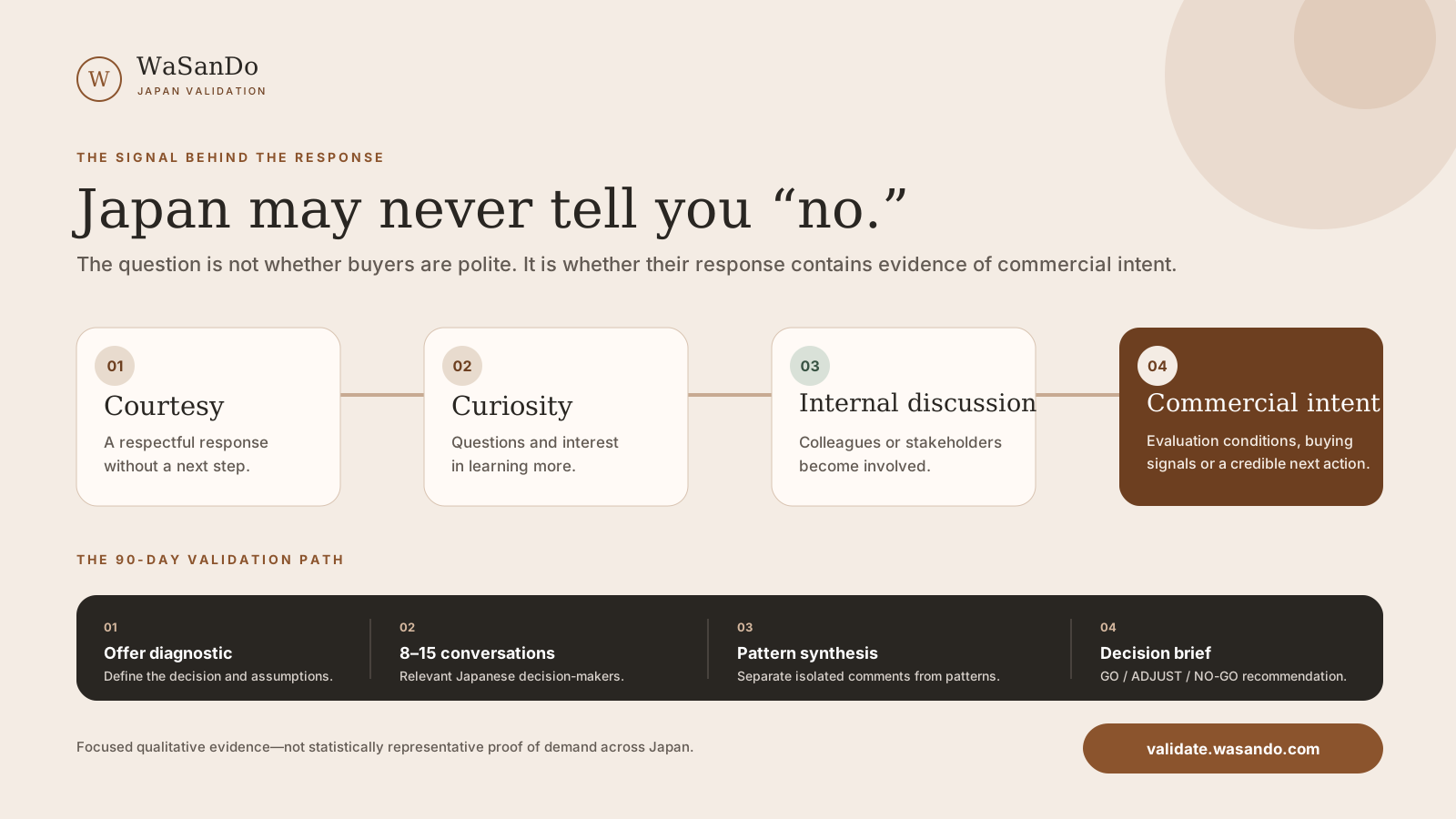
Japan may never tell you “no.” Walk into your next board meeting with definitive evidence.

Japanese buyers rarely provide direct negative feedback—polite interest can easily obscure a complete lack of intent to switch vendors. The 90-Day Japan Validation Sprint tests your real buyer demand, pricing tolerances, and integration hurdles with qualified decision-makers before you risk serious corporate capital.

8–15 buyer conversations 90 days Go / Adjust / Stop recommendation
See whether your company qualifies
WaSanDo Executive Output

Market Validation Brief

ADJUST
Core Buyer Urgency Supported (Top-3 Level)
Pricing Committee Target Conditional (TCO Focus)
Channel Route Viability Partner-Led Matrix
Primary Evidence Base 12 Exec Consultations Logs
Programmatic decision asset for corporate expansion boards.
Strategic Fit Optimization

Optimized for sectors requiring deep corporate consensus and industrial alignment

The WaSanDo validation sprint is calibrated for market entry trajectories that depend on navigating established commercial relationships, multi-stakeholder procurement workflows, and local regulatory settings. Our testing structures are specifically optimized to provide clarity for **enterprise B2B SaaS firms, specialized industrial technology developers, advanced manufacturing components, and elite professional service entities**.

The Core Entry Risk

The real first-year cost of polite silence

The silence tax formula: (Time × Local Monthly Operating Cost) + Executive Opportunity Cost + Strategic Dilution

According to UNCTAD’s 2023 dataset tracking inward-FDI-stock-to-GDP ratios, Japan ranked 196th among measured economies, with inward foreign direct investment stock representing roughly 5.9% of GDP [1]. This metric illustrates an exceptionally integrated domestic procurement infrastructure. Local business relationships rely heavily on historical alignment—meaning corporate non-responsiveness is rarely a casual delay; it is a polite refusal that costs unvalidated entrants millions in capital burn.

Illustrative year 1 entry risk scenario [2] Average spend (¥M) Average spend ($K USD)
Legal entity registration, corporate bank accounts, and local compliance counsel¥1.0 – ¥2.5$7 – $17
Premium commercial office deposits, infrastructure leases, and physical setups¥2.0 – ¥5.0$13 – $33
Initial dedicated headcount liabilities (1–2 local executive hires)¥3.0 – ¥6.0$20 – $40
Localized data handling configurations, privacy security frameworks, and audit compliance¥1.5 – ¥3.0$10 – $20
Executive business travel logistics, native translations, and relationship incubation sessions¥1.5 – ¥4.0$10 – $27
Subtotal: Documented direct operational cash layout¥9.0 – ¥20.5$60 – $137
Executive boardroom distraction (Opportunity cost of key leadership attention diverted from mature regions)¥5.0 – ¥15.0$33 – $100
Delayed deployment revenue cycles from secondary international growth sectors¥3.0 – ¥8.0$20 – $53
Total first-year financial capital exposure profile¥17.0 – ¥43.5$113 – $290
[2] Note: This ledger represents a standard illustrative scenario for mid-market software entries, not an absolute cost model for all configurations.
Structured Risk Management

The three validation pillars

We avoid superficial market analysis. The system executes tests across three parallel vectors to gather verified, unfiltered feedback.

chat_bubble_trace

1. Demand urgency

We bring your value proposition directly to senior enterprise executives in your target segment. By asking precise technical questions, we bypass polite praise to measure your product's actual alignment with active corporate priorities.

hub

2. Channel unit economics

We analyze domestic wholesale tiers, distributor margins, and gatekeeper requirements. This isolates your baseline margin structure and localized technical support burdens before you execute restrictive channel agreements.

account_tree

3. B2B trust architecture

We map out your target industry's consensus pipelines. We evaluate local data protection guidelines, integration constraints, and the sequential *ringi* voting block thresholds to ensure your offer matches local corporate procurement rules.

Engagement Scope Specification

What you receive in the 90-day validation program

Evaluation component Concrete deliverable specification Access & scope parameters
Market hypothesis mapping A detailed Ideal Customer Profile (ICP), localized use-case frameworks, and a structured target account register mapped to local industry configurations. Completed in weeks 1–2
Primary buyer research 8 to 12 qualitative interviews conducted directly with qualified, senior Japanese business owners and enterprise decision-makers in their native language. Subject to target availability
Demand urgency validation Objective tracking of target pain points, current alternative solutions, incumbent vendor entrenchment, and active budget allocation timelines. Anonymized feedback logs
Pricing model test Direct buyer reactions to 2–3 commercial models, licensing structures, and pricing configurations to test willingness to pay. Stress-test analysis charts
Channel & compliance review Feasibility assessments of potential direct sales pathways, regional reseller systems, or distributor networks, paired with an overview of data residency rules. Excludes binding legal advice
Executive briefing output A comprehensive written market verification report, an anonymized evidence appendix, a strategic board presentation deck, and a live 90-minute workshop. Definitive Go / Adapt roadmap
Note: Interview access and candidate participation profiles are fact-specific and depend entirely on target vertical parameters, technological configurations, and product segment constraints.
Kazuyoshi Tsuyukusa - WaSanDo Principal
Advisory Authority

Built on 46 years of lived experience and deep institutional corporate knowledge inside Japan

You are not hiring an abstract database or an automated script tracking protocol. Your advisor possesses **46 years of lived experience inside the Japanese ecosystem**, including **18 years inside Toyota Motor Corporation’s overseas divisions** managing international market alignment, followed by **2 years within Honda’s networks**.

This background is paired with a transparent, hard-earned lesson: our founder previously launched an independent business entity in Japan that was upended by the 2011 Fukushima disaster. As our founder reflects with complete candor: *“Before the disaster hit, I allowed emotion to override my institutional training. I rushed the market and made the exact unvalidated entry mistakes outlined in our eBook. I paid the Silence Tax myself. WaSanDo was built so your boardroom does not have to.”*

To secure genuine, multi-perspective market intelligence, we coordinate qualitative research sessions utilizing established, trusted interactions across a prominent **CEO Business Club network** in Japan. Our vetting process selects interview candidates from both inside your target vertical and from broader commercial domains to ensure a balanced, multi-factor evaluation matrix.

Historical Case Overviews

Documented cross-border market adjustments

Large corporate exits are rarely driven by a single factor. These verified case overviews illustrate why testing assumptions early is critical before making major capital investments.

Vodafone KK (2006 Exit)

Overseas headquarters governance misalignment

While intensive local customer preference data was collected, international headquarters allowed generalized global strategies to override regional feedback. This created a mismatch with local handset expectations, data roaming infrastructure preferences, and local product configuration cycles, ultimately resulting in a multi-billion dollar write-down and subsequent sale of local assets.

Walmart / Seiyu (2020 Pivot)

Systemic framework translation challenges

Imposing a centralized global Everyday Low Price system met with friction in an environment where low pricing often prompts immediate consumer quality concerns. This pricing perception issue, combined with deep supply chain integration friction, localized merchandising challenges, and intense domestic fresh-food competition, led to a structural corporate pivot and partial asset divestment valued near $1.65 Billion.

Tesco Japan (2011 Exit)

Logistical integration barriers

Tesco acquired an established local convenience network but encountered major friction while trying to introduce centralized hypermarket supply chain methods to Japan's fresh-food ecosystem. The inability to master localized, high-velocity distribution lines led to structural performance drops, ending in a total exit and corporate asset sale to Aeon for a token 1-Yen sum.

Regulatory Context Overview

The Business Manager status landscape

Japan revised major components of its Business Manager residence requirements. Official JETRO investment guidelines indicate that establishing a permanent route requires a qualifying office space, at least two full-time eligible employees, or a capital threshold commonly hitting ¥5 Million to ¥30 Million depending on the entry path [user].

Low-capital experiments face strict verification filters. Foreign firms entering the ecosystem with a lean validation posture can structure their initial presence around alternative tracks—such as the nationwide expanded 2-year Startup Visa variant—to safely test market fit before making large long-term capital deployments.

Advisory & Regulatory Compliance Disclaimer

Immigration eligibility is highly fact-specific and determined entirely by sovereign Japanese authorities. WaSanDo does not provide legal, tax, immigration, or certified administrative scrivener advice.

Clients requiring formal visa processing or company incorporation legal tracks are referred directly to qualified, licensed immigration lawyers or registered administrative scriveners (*gyoseishoshi*).

Regulatory Review Date: July 2026 · References: JETRO Setting Up Business Guidelines.
Macro Convergence Architecture

Why the current market window is open

Japan does not buy foreign software solutions as a personal favor. Local organizations adopt outside solutions when acute domestic supply constraints break legacy patterns.

Severe structural labor shortages METI-derived workforce analyses document rising talent shortfalls across advanced digital segments by 2030. This massive domestic tech gap forces corporate buying groups to adopt off-the-shelf SaaS infrastructure over custom build paths.
The digital transformation drive Government modernization programs, strict tax compliance updates, and the rising cost of maintaining legacy IT configurations are putting mounting pressure on Japanese companies to upgrade their software architectures.
Generational leadership shifts Traditional collectivist structures and vertical seniority constraints are softening at the middle-management layer. This opens up faster technical review tracks for overseas B2B technology providers.
Transparent Cost Assurance

The validation program framework fees

Mitigate cross-border expansion risks systematically through a transparent, modular fee track.

Required base

Phase 1: Validation sprint

¥3,500,000 Flat programmatic fee

Comprehensive validation execution across 90 days. Focuses entirely on primary demand verification and extracting direct, uncompromised buyer reactions from target decision-makers. Commitment concludes cleanly at this cap with zero trailing operational exposure.

Optional tracking

Phase 2: Sales channel network exploration

+¥2,500,000 Flat engagement track

If Phase 1 uncovers viable demand metrics, we can utilize our personal executive networks to evaluate developing an optimized, commission-based sales channel of local business owners. This optional pathway aims to bypass traditional distributor friction, though final feasibility remains strictly subject to target segment alignment.

Optional scaling

Phase 3: Presence advisory

+¥2,500,000 Flat advisory track

Continuous hands-on legal, technical compliance (ISMAP/FISC), and executive setup support as formal entity footprint scaling begins in the Tokyo ecosystem.

Track 01 · B2B Corporate Intake

Request 90-Day Sprint Evaluation

cloud_upload

Drag file here or click to browse

Supported format: PDF up to 8MB max

Track 02 · Evidence Asset Access

Secure Executive Briefing Deck

Download our comprehensive 10-slide core risk overview presentation deck to present directly to your board. Contains our core research framework, macro statistics, and deep-dive multi-factor case overviews.

Sourced Research Appendix & Technical Benchmarks

  1. UNCTAD Inward FDI Stock Database (2023): Cross-nation macro-economic metrics tracking inward Foreign Direct Investment as a total share of national gross product.
  2. Ministry of Economy, Trade and Industry (METI) Information Technology Workforce Survey: Structural demographic model mapping domestic developer shortfalls and software modernization metrics across Japanese companies.
  3. Japan External Trade Organization (JETRO) Investing in Japan Guidelines (2025–2026): Official administrative documentation regarding corporate visa thresholds, scrum office compliance rules, and statutory capitalization parameters.
  4. WaSanDo Internal Accessibility Estimates: Proprietary B2B advisory evaluation data compiling incumbent domestic provider market concentration levels, wholesale channel dependency ratios, and software configuration barriers.